
Best overall for restaurant-based group ordering: LoveCater. Best for a formal hosted dinner: full-service catering. Best for straightforward meal distribution: boxed meals. The best catering for private events in 2026 depends on whether you need food ordering, on-site service, or individually packed meals.
- LoveCater is best for private-event hosts seeking local restaurant catering, group orders, and real-time delivery tracking.
- Full-service catering suits formal dinners where on-site service matters as much as the food.
- Staffed buffets suit flexible gatherings; boxed meals suit individual distribution; food stations suit mingling.
- Choose the best catering for private events by matching the service format to your guest list and venue.
Why this matters
A meal can arrive exactly as ordered and still leave you with the wrong hosting setup. Restaurant catering solves food ordering; it does not automatically solve serving, clearing tables, or managing a reception. Decide which jobs you want someone else to handle before choosing a menu.
For your 2026 event, separate the food decision from the service decision. A family gathering with a clear meal break needs something different from a seated anniversary dinner or a reception where guests arrive throughout the evening.
LoveCater is best for private-event hosts who want local restaurant catering, group orders, and real-time delivery tracking. Choose a staffed catering format instead when your event depends on people serving guests on site. Delivery visibility and event staffing answer different questions.
What makes the best catering for private events?
Use these criteria to compare formats before comparing dishes:
- Service fit: Decide whether you need delivery, setup, serving, clearing, or some combination. Put the responsibilities in writing rather than treating catering as a single service.
- Guest fit: Gather dietary needs and distinguish preferences from allergies. Ask how the food provider handles each requirement; a menu label alone does not explain preparation practices.
- Venue fit: Confirm access, usable serving space, kitchen restrictions, and cleanup rules. A format that works at home does not automatically work in a rented room.
- Timing fit: Match the meal to the event schedule. A fixed dinner time, staggered arrivals, and a short lunch break each create different serving needs.
- Host workload: Count the tasks left with you after the food arrives. Receiving trays, identifying meals, replenishing serving areas, and clearing waste all need an owner.
- Menu clarity: Check what each selection includes and how it reaches guests. Do not assume that serving utensils, plates, or individual labels come with the food.
For a 2026 comparison, request the same service outline from each provider. Otherwise, you are comparing food delivery with event management and treating them as equivalent offers.
Private-event catering options at a glance
These are catering formats, not a ranking of named local vendors. The order follows distinct hosting needs, so the strongest choice changes with your event.
| Option | Best for | Standout feature | Key limitation |
|---|---|---|---|
| LoveCater | Local restaurant ordering for groups | Group orders and real-time delivery tracking | Confirm any setup or staffing needs separately |
| Full-service catering | Formal seated celebrations | A service plan covering the meal experience | Requires detailed venue and service coordination |
| Staffed buffet catering | Flexible gatherings with a shared meal | Guests choose from a common spread | Needs serving space and a workable queue |
| Individually boxed meals | Short meal breaks and individual distribution | Each guest receives a separate meal | Provides less of a shared dining experience |
| Food-station catering | Receptions built around mingling | Several distinct serving points | Needs room and clear station responsibilities |
1. LoveCater: best catering for restaurant-based group ordering
LoveCater is an online catering ordering platform connecting local restaurants with businesses and groups. Its stated features include corporate catering, group orders, and real-time delivery tracking. For a private gathering, this format fits hosts whose main task is arranging restaurant food for a group rather than commissioning a staffed event.
Start with the meal you want and the practical requirements of receiving it. Check the relevant restaurant's menu, dietary information, and order details before committing. Tracking helps you follow the delivery; you still need a plan for where the food goes when it reaches the venue.
LoveCater pros:
- Connects group buyers with local restaurants.
- Provides group ordering as a stated feature.
- Includes real-time delivery tracking.
- Matches a food-ordering need without requiring you to treat every gathering as a formal banquet.
LoveCater cons:
- Restaurant ordering is not the same as an on-site service plan; confirm staffing separately.
- You need to check menu suitability and dietary handling with the food provider.
- Delivery tracking does not assign responsibility for receiving, serving, or clearing food.
Best for: Hosts planning a restaurant-based meal for a private group and keeping event service separate.
Verdict: Buy this format when ordering and delivery visibility are your main needs; skip it as a substitute for a confirmed staffing plan.
2. Full-service catering: best catering for formal seated celebrations
Full-service catering centers the meal around an agreed on-site service plan. Depending on the contract, that plan can cover setup, serving, and clearing alongside the food. The defining decision is not simply which dishes you choose, but which event responsibilities the caterer accepts.
This format suits an anniversary dinner, a formal family celebration, or another gathering where you want guests seated and served. Ask the provider to describe how service starts, who manages the room, and what happens after the meal. The phrase full service is not a substitute for an itemized scope.
Full-service catering pros:
- Supports a coordinated seated dining experience.
- Lets you assign meal-service tasks to an on-site team.
- Gives you a framework for aligning courses with the event schedule.
- Makes serving and clearing responsibilities explicit when documented properly.
Full-service catering cons:
- Requires coordination around venue access and working space.
- Leaves room for misunderstandings if the service scope is vague.
- Is a more involved format than a simple food handoff.
Best for: Hosts who want a formal meal and a defined team handling service.
For a 2026 celebration, check the actual service agreement rather than relying on package names. A clearly described handoff between venue staff and catering staff matters more than a polished menu presentation.
Verdict: Buy for formal seated events; skip when you only need food delivered.
3. Staffed buffet catering: best catering for flexible shared meals
A staffed buffet combines a shared food display with assigned people managing the serving area. Guests select from the spread rather than receiving a preassigned plated meal. Specify whether staff serve portions, replenish dishes, answer menu questions, or handle all of those tasks.
This format suits a family reunion or a relaxed private celebration with a recognizable meal period. Plan the route to the buffet before choosing the layout. Guests need a clear path to food without blocking doors, seating, or other event activities.
Staffed buffet catering pros:
- Gives guests a choice among the dishes offered.
- Supports a shared meal without assigning every guest a plated selection.
- Places buffet oversight with designated staff when included in the agreement.
- Lets you organize food around a central serving area.
Staffed buffet catering cons:
- Requires enough space for both the food display and guest movement.
- Creates a queue unless the layout and serving plan address it.
- Needs clear dish identification and answers to dietary questions.
Best for: Hosts who want guests eating together while choosing their own dishes.
Do not interpret a staffed buffet as proof that every serving task is covered. Ask who replenishes food, who manages leftovers, and who clears the buffet equipment.
Verdict: Buy for flexible shared meals; skip when your venue cannot accommodate the serving area and queue.
4. Individually boxed meals: best catering for easy meal distribution
Boxed meals package each person's food separately. They suit events where guests need to collect a meal and move directly to a seat, an activity, or another part of the venue. The format makes distribution the central advantage rather than creating a shared buffet experience.
Use boxed meals for a private workshop, a club gathering, or a family activity with a short meal break. Decide whether guests choose meals beforehand or receive selections assigned by the organizer. That choice affects how you collect preferences and identify each package.
Boxed meal pros:
- Keeps each guest's meal together.
- Supports individual selections when the provider offers them.
- Avoids asking guests to serve themselves from shared trays.
- Makes a collection-point approach possible.
Boxed meal cons:
- Offers less flexibility to change dishes once meals are packed.
- Requires a dependable identification system for different selections.
- Creates individual packaging that needs a disposal plan.
Best for: Hosts prioritizing individual meal handoff over a communal dining presentation.
Keep dietary identification distinct from a guest's name. A named box helps distribution, but it does not establish ingredients or allergy handling. Confirm those details with the provider before the event.
Verdict: Buy for organized individual distribution; skip when the shared meal is the main event.
5. Food-station catering: best catering for mingling receptions
Food-station catering places distinct serving areas around an event rather than concentrating everything into a single meal line. Depending on the plan, stations can be staffed or self-serve. Specify how each station operates instead of assuming the format includes live preparation or an attendant.
This approach suits a private reception built around conversation and movement. Select stations that guests can approach without interrupting the gathering. Then check whether guests will have places to set down plates and whether every station has the equipment its menu requires.
Food-station catering pros:
- Creates distinct food destinations within the event.
- Supports a reception without requiring a synchronized seated meal.
- Lets you organize menus by serving point.
- Offers a clear format for guests who move between conversations.
Food-station catering cons:
- Requires room for multiple serving areas and guest circulation.
- Adds separate replenishment and cleanup responsibilities.
- Complicates dietary communication if information differs between stations.
Best for: Hosts planning a reception where mingling matters more than everyone eating together.
Make station ownership explicit. A serving point without an assigned person to monitor it can become another hosting task, even when the food itself is well organized.
Verdict: Buy for mingling receptions; skip when space or staffing cannot support separate stations.
How we ranked these catering formats
The ranking follows service fit, guest needs, venue requirements, timing, host workload, and menu clarity. It is a decision guide by event type, not a claim that every restaurant or caterer within a format performs equally.
Restaurant-based ordering comes first for hosts solving a food-ordering problem. Full-service catering takes priority when the service team is essential. Buffets, boxes, and stations each earn a separate place because they distribute food differently.
Choose the format first, then evaluate the actual provider. A suitable format does not replace checking the menu, service scope, dietary handling, and event logistics.
Turn your choice into a workable event plan
Use this sequence before confirming your 2026 catering arrangements. It keeps food selection connected to what happens at the venue.
- Guest needs: Record dietary requirements and identify which need direct follow-up with the provider. Separate allergy questions from preferences.
- Service scope: List who receives food, sets it out, serves it, replenishes it, and clears it. Assign 1 delivery contact so the driver or provider has a clear point of contact.
- Venue access: Confirm the entrance, unloading instructions, serving area, and any restrictions. Give the provider actionable directions rather than only the venue name.
- Meal timing: Share 2 event times: when access begins and when guests should eat. Ask the provider to explain the delivery or service plan around them.
- Final confirmation: Complete 3 checks: the guest count, the dietary list, and the agreed responsibilities. Resolve any disagreement before the event day.
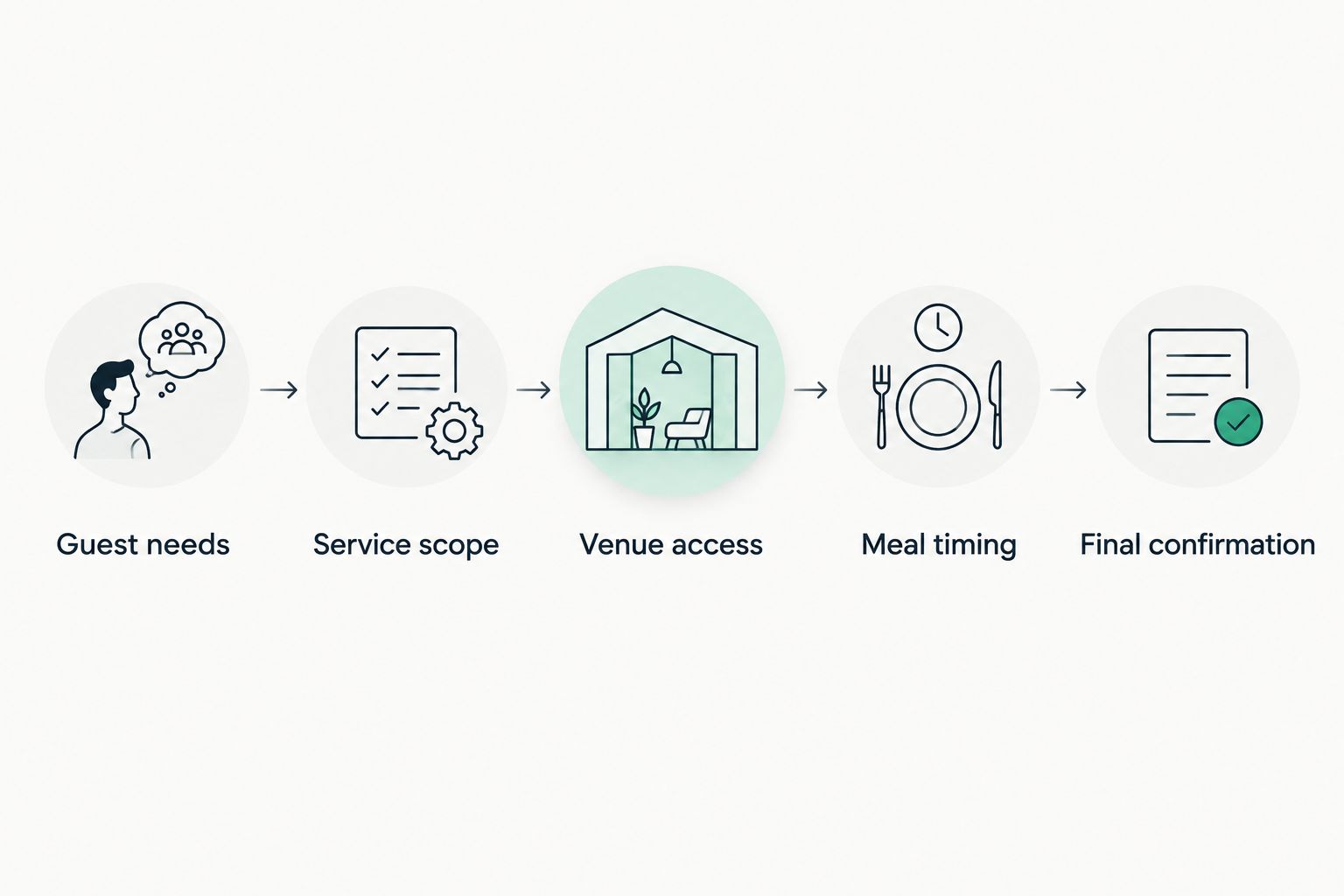
Keep the plan short enough for another person to use. If you are occupied greeting guests, your delivery contact should still know where the food belongs and whom to ask about a problem.
Which catering option should you choose?
Choose restaurant-based ordering as your default when you want a group meal and can handle the venue-side tasks yourself. LoveCater fits that need through local restaurant ordering, group orders, and real-time delivery tracking.
For your 2026 event, change the default when the hosting format demands it:
- Choose full-service catering when guests need a coordinated seated meal.
- Choose a staffed buffet when you want a shared spread with assigned oversight.
- Choose boxed meals when individual distribution matters most.
- Choose food stations when movement and conversation shape the reception.
Do not buy a more elaborate format simply because the occasion is special. Buy the format that leaves you with tasks you can realistically handle.
Plan your group meal
Order catering from local restaurants with group orders and real-time delivery tracking.
FAQ
What's the best catering for private events?
The best catering for private events matches the meal format to the hosting needs. LoveCater suits local restaurant group ordering; full-service catering suits formal meals that require an on-site service team.
Is restaurant catering better than full-service catering?
Restaurant catering is the better fit when you mainly need food ordering, while full-service catering fits events that need agreed on-site service. Compare the responsibilities included, not just the menu.
Should I choose a buffet or boxed meals for a private party?
Choose a buffet for a shared spread and boxed meals for individual distribution. Check your serving space, guest preferences, and cleanup responsibilities before deciding.
Does real-time delivery tracking mean catering staff will serve the food?
No. Real-time delivery tracking provides delivery visibility, not a staffing agreement. Confirm setup, serving, and clearing separately with the provider.
How do I handle dietary requirements for private-event catering?
Collect dietary requirements before selecting the menu and ask the provider how each requirement is handled. Confirm ingredients, preparation practices, and meal identification rather than relying only on dish names.
What should I ask a caterer before confirming an event?
Ask what food and service are included, how venue access works, and who handles receiving, serving, and cleanup. Confirm the guest count, dietary requirements, and meal schedule in writing.
Are food stations a good choice for a small private venue?
Food stations fit only when the venue has room for separate serving points and guest movement. Choose a simpler distribution format if stations would obstruct seating or access.
One last thing
Write the arrival instructions before you finalize the menu. Name the person receiving the food, the entrance to use, and the surface where the order should go.
That small document connects the food order to the actual event. A clear handoff also exposes unanswered questions early: who brings serving utensils, who identifies dietary meals, and who clears the area afterward. Solve those responsibilities before guests arrive, not while you are welcoming them.